
Your bet and what it buys
The same game costs three very different amounts, and the buy menu is where you feel it.
Four RTP configurations, and yours#
3 Piggies of Bank runs four RTP configurations: 96%, 94%, 92% and 90.5%. Which one you meet is up to the casino: open the game info and read the line before you raise the bet. That sentence is the whole answer, and everything below it is detail.
The confusion in search results comes from perfectly honest sources describing different builds. Yggdrasil’s own shop window calls the game 96% and more, because that is the top configuration it licenses. The launcher the provider serves to the public runs 94.0%, because that is the build sitting on the demo server. A review that spins the demo and a review that reads the vendor page will print different numbers and both will be telling the truth about what they looked at.
| Configuration | What it means | Where you see it |
|---|---|---|
| 96% | The top build, the one the provider advertises | Lobbies that license the highest setting |
| 94% | The 94% configuration, and the one the public demo runs | The free demo on our demo page , and many live lobbies |
| 92% | A lower setting available to operators | Read the game info line to know |
| 90.5% | The lowest build the game ships | Read the game info line to know |
RTP describes the game’s long average, not tonight’s outcome. Over a single session the difference between 96% and 90.5% will be invisible under the noise of ordinary variance; over a long stretch at a fixed stake it is the difference between two versions of the same slot. Since checking costs nothing, check.
Low volatility and a 25.2% hit frequency#
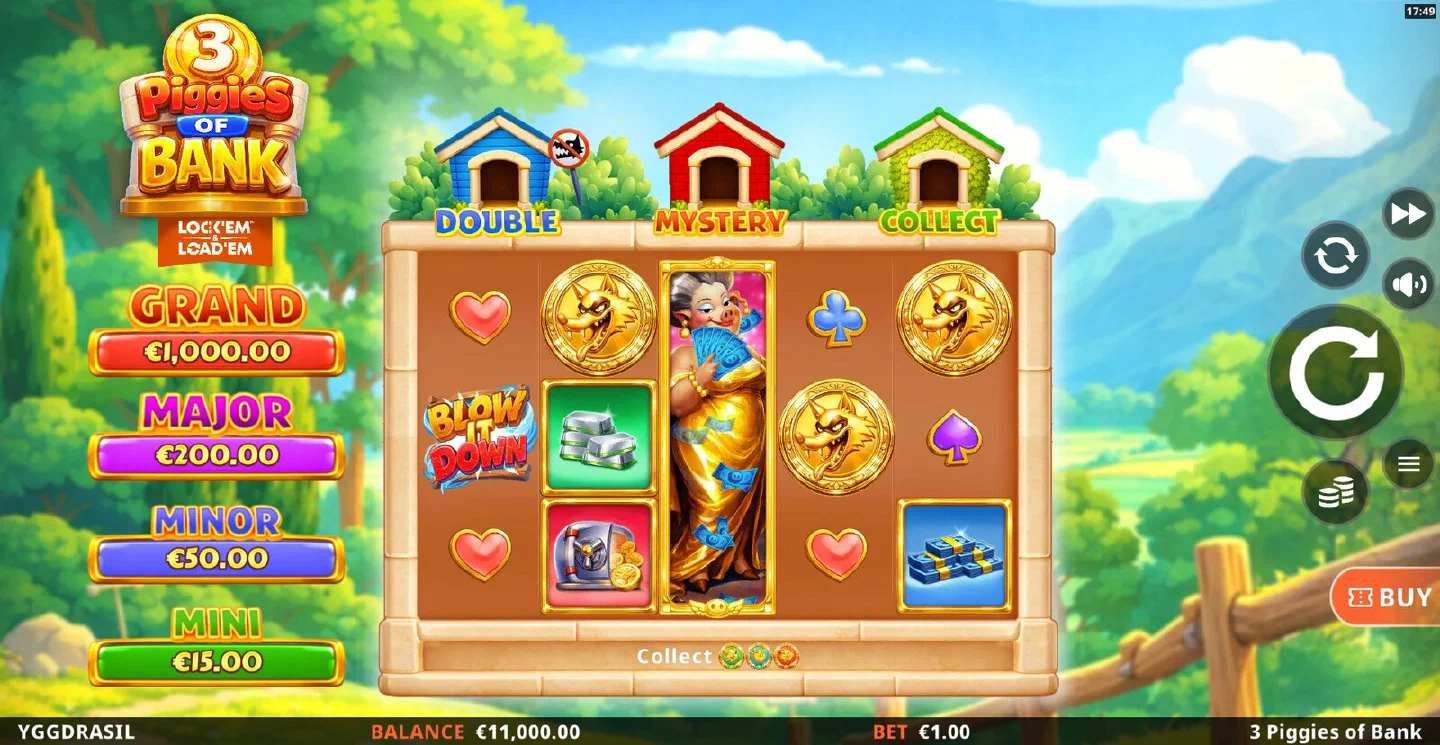
Yggdrasil rates this game low volatility, and the hit frequency puts a number on the label: 25.2% of spins return something, which is roughly one in four. Those returns are mostly small. At the EUR 1.00 bet the four card suits pay EUR 0.20 for three, EUR 0.40 for four and EUR 2.00 for five, and they are by some distance the most common results on the board.
What that combination buys you is time at the table. A game that pays on one spin in four keeps a balance alive through the stretch where nothing dramatic is happening, and in a slot whose real range lives inside a bonus round, staying at the table is the point. The trade is equally clear: the base game will rarely produce a result big enough to change your session on its own.
It also explains why bet sizing matters more here than in a high-variance game. With frequent small returns the effective cost per spin is gentler than the nominal one, so a stake one step up from where you would normally sit is often still sustainable. Our strategy page works through that with the buy prices attached, because the buy menu is where a bet size stops being theoretical.
One thing the hit frequency does not describe is how often the bonus arrives. That is a separate question, and the honest answer on this page is the mechanical one: six or more Wolf Coins together with one Piggie Coin open Lock ’em & Load ’em, and the game can also start it at random while Piggie Coins are being collected.
The cap: 5,625x the bet#
The ceiling applies to one round: 5,625x the bet. The path there is the one the rules describe: Coins lock, the Collect Coin takes the sum of everything on the board, and a full board of 15 Coins pays the Grand at 1,000x.
In cash, at the stakes the game offers:
| Bet | 5,625x cap | Grand at 1,000x | Major at 200x |
|---|---|---|---|
| EUR 0.10 | EUR 562.50 | EUR 100.00 | EUR 20.00 |
| EUR 1.00 | EUR 5,625 | EUR 1,000 | EUR 200.00 |
| EUR 20.00 | EUR 112,500 | EUR 20,000 | EUR 4,000 |
Notice that the Grand is not the cap. The ladder tops out at 1,000x while the round tops out at 5,625x, which tells you something structural about how a maximum round is built: the Grand is one component of it, not the whole thing. The coins on a full board carry their own values (Wolf Coins at 1x to 10x, Mystery Coins at up to 150x, Double Coins multiplying every value on the board by x2 and then taking up to 150x themselves) and the Grand sits on top as a separate award for filling all fifteen positions.
The Wild contributes to the base game rather than the bonus. Mamma Pig expands in stages carrying 1x, 2x and 3x, those multipliers are added and applied to the total win, and 15x is the published ceiling, reached on a board of five fully expanded Wilds. Put that against the ladder and it stays modest: a five-vault line worth EUR 15.00 at the EUR 1.00 bet reads EUR 45.00 with one fully expanded Wild in it, while the Major pays EUR 200.00 and the Grand EUR 1,000. The range in this game lives in the bonus, not on a payline.
The ladder is worth costing at the same three stakes, because it is the part of the maths a player meets most often. Mini at 15x is EUR 1.50, EUR 15.00 and EUR 300.00; Minor at 50x is EUR 5.00, EUR 50.00 and EUR 1,000; Major at 200x is EUR 20.00, EUR 200.00 and EUR 4,000. Read the Mini row against a base spin and the scale of the bonus becomes concrete: the smallest prize on the ladder is fifteen base spins back in one award, and the Major is two hundred of them. Mini, Minor and Major are paid when a special Coin lands during the round, while the Grand is the one with the visible condition, all 15 positions filled.
How the lines pay#
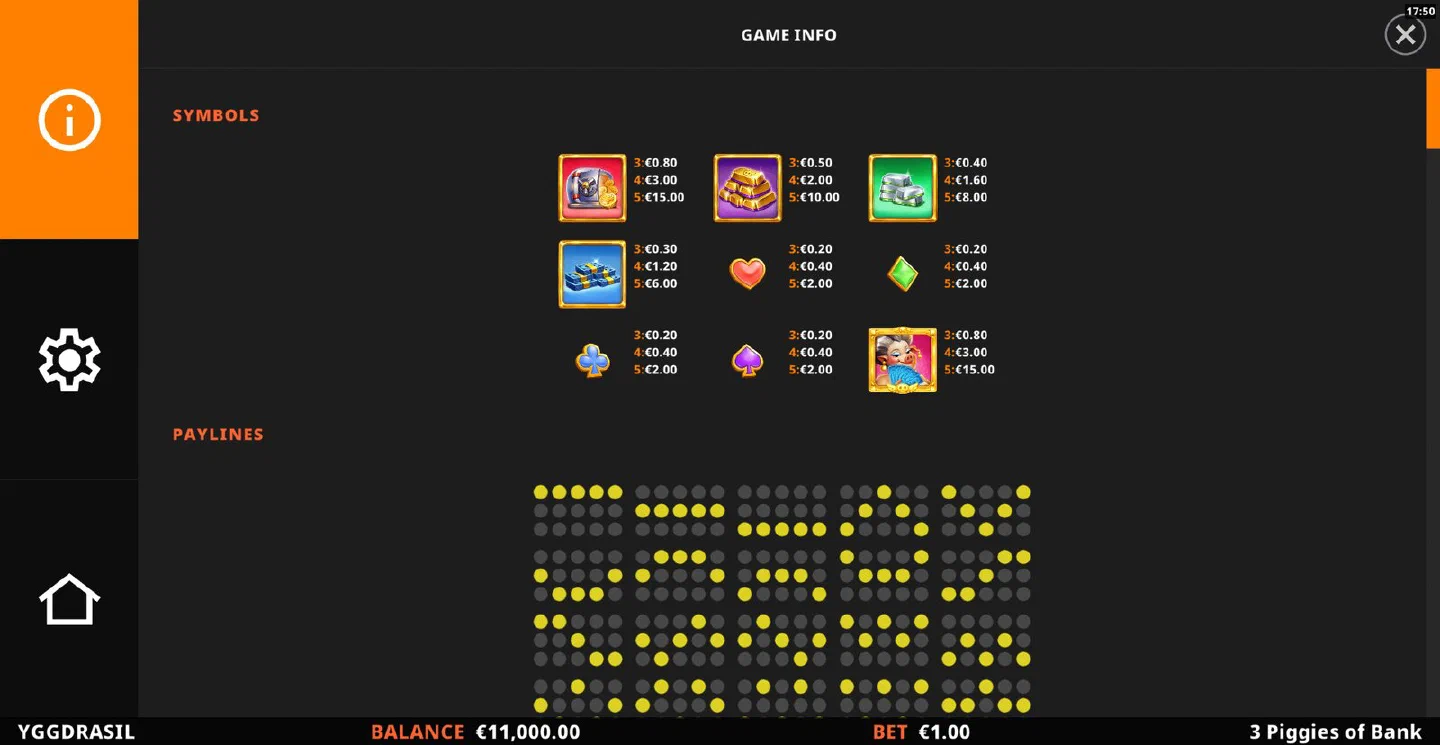
Twenty-five fixed paylines, left to right from the leftmost reel, highest combination per line only. The pay table is printed dynamically in cash at your current stake, so the figures below are what you see at the EUR 1.00 default.
| Symbol | Three | Four | Five |
|---|---|---|---|
| Vault / Safe | EUR 0.80 | EUR 3.00 | EUR 15.00 |
| Mamma Pig (Wild) | EUR 0.80 | EUR 3.00 | EUR 15.00 |
| Gold bars | EUR 0.50 | EUR 2.00 | EUR 10.00 |
| Silver bars | EUR 0.40 | EUR 1.60 | EUR 8.00 |
| Cash stacks | EUR 0.30 | EUR 1.20 | EUR 6.00 |
| Heart, Diamond, Club, Spade | EUR 0.20 | EUR 0.40 | EUR 2.00 |
Two readings are worth taking from that table. First, the gap between four and five symbols is enormous compared with the gap between three and four: the safe goes from EUR 3.00 to EUR 15.00, a five-fold step, while three to four is under four times. A full line is the base game’s real prize. Second, the card suits sit at a flat EUR 0.20 for three regardless of suit, which is why a quarter of your spins returning something does not translate into a balance that grows: it translates into a balance that leaks slowly.
Move the stake and everything scales with it. At EUR 0.10 the five-safe line is worth EUR 1.50; at EUR 20.00 it is worth EUR 300.00. The features page has the symbol hierarchy in full, with the Wild and Scatter behaviour attached.
Your bet: EUR 0.10 to EUR 20.00#
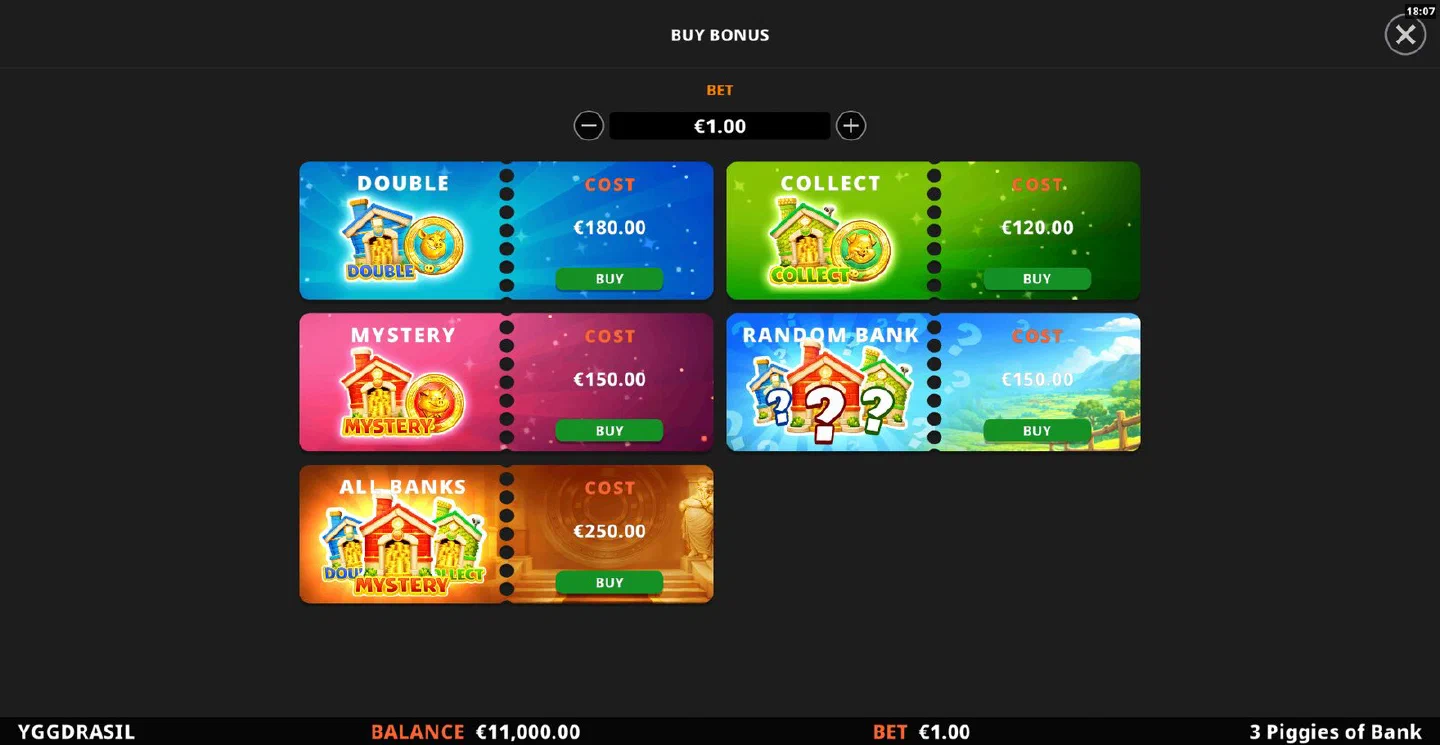
The same slot costs three very different amounts to play, and the buy menu is where you feel it.
| Bet | Collect 120x | Mystery / random 150x | Double 180x | All three 250x |
|---|---|---|---|---|
| EUR 0.10 | EUR 12.00 | EUR 15.00 | EUR 18.00 | EUR 25.00 |
| EUR 1.00 | EUR 120.00 | EUR 150.00 | EUR 180.00 | EUR 250.00 |
| EUR 20.00 | EUR 2,400 | EUR 3,000 | EUR 3,600 | EUR 5,000 |
At the floor of the bet range the entire menu is within reach of an ordinary budget: all three banks cost EUR 25.00, which is 250 base spins at that stake, and the base game around it still costs EUR 0.10 a turn. At the default stake the same ticket costs EUR 250.00, which is a session decision rather than an impulse. At the top of the range it is EUR 5,000, and the game has stopped being the calm table its volatility rating describes.
That is the practical argument for playing this slot near the bottom of its range: the low-volatility base game is designed to be survived cheaply, and the money you save there is what pays for the part of the game you actually want to see. Autoplay helps with the grind where the market allows it: the provider describes those panel controls as available in selected markets, and rules differ between jurisdictions.

The maths of a bonus buy#
Every purchase in the panel leads into the same bonus game and carries the same 94.0% theoretical return. That second point is the useful one, because it removes the usual question. Nothing in the menu is better value than anything else; the price differences reflect what each bank does, not a better or worse deal.
A buy price is a price, not a frequency. Collect at 120x means the round costs you the equivalent of 120 base spins at your current stake. Double at 180x costs exactly one and a half times as much as Collect, which is what you would expect from a bank that multiplies the whole board by x2 before taking a value of its own. All three banks at 250x undercuts buying Collect and Double as separate rounds, which would run to 300x.
The menu a given market shows is the one that counts, so treat the prices above as the game’s list and the panel in front of you as yours. Then bring the two halves of this page together: the buy price sets what a round costs, the RTP configuration sets what the game returns over the long run, and the bet you pick decides whether either number matters to your evening. The 3 Piggies of Bank hub has the rest of the game, and the full review puts a verdict on it.