

Pace and the pause
The controls that set the speed of a session, and the rule that covers an interruption.
What low volatility means in practice#
Yggdrasil rates 3 Piggies of Bank low volatility, and the hit frequency of 25.2% puts a figure behind the label: roughly one spin in four returns something. In this game those returns are mostly card-suit lines worth EUR 0.20 to EUR 2.00 at the EUR 1.00 bet, with the occasional four-of-a-kind on a vault symbol sitting above them.
A low rating changes the shape of a session, not the odds of it. What it buys, in planning terms, is duration: the practical ability to stay at the table long enough to reach the bonus, whether you wait for it or buy your way in. In a high-variance slot a budget evaporates in sharp steps; here it drains gently, and the balance keeps twitching upward often enough that a session has texture rather than silence.
That has one important consequence for planning. Because the effective cost per spin is softened by frequent small returns, a stake one notch above your instinct is often still sustainable. The reverse is also true: the low-volatility character means the base game is unlikely to rescue a session on its own, so betting high in the hope that it will is working against the design. Our RTP page sets out the four configurations and the maths of the ceiling in full.
What the volatility rating does not tell you is how often the bonus arrives. That is a separate question, and the honest answer is the mechanical one: six or more Wolf Coins with a Piggie Coin, or a random start while Piggie Coins are being collected.
Pick the bet by budget, not by feel#
Start with the division, not with the slider. Budget divided by bet is the number of base spins you have bought, and it is the single most useful sum in this game.
| Your bet | Spins from a EUR 100 budget | Cost of the Collect buy | Cost of all three banks |
|---|---|---|---|
| EUR 0.10 | 1,000 | EUR 12.00 | EUR 25.00 |
| EUR 1.00 | 100 | EUR 120.00 | EUR 250.00 |
| EUR 20.00 | 5 | EUR 2,400 | EUR 5,000 |
The bottom row is the instructive one. At the maximum bet a EUR 100 budget is five spins, and the cheapest buy in the game costs twenty-four times the whole budget. That is not a criticism of the stake: it is a reminder that the top of the range belongs to a completely different bankroll, and that the game’s calm reputation is a description of the EUR 0.10 and EUR 1.00 tables rather than the EUR 20.00 one.
The top row shows the opposite extreme and it is genuinely attractive. At EUR 0.10, a hundred euros buys a thousand base spins and every purchase on the menu costs between EUR 12.00 and EUR 25.00. You can play the base game properly, buy each of the three banks once to see what they do, and still have most of the evening left. For a slot whose interest lives inside a bonus round, that is the stake at which the whole design is accessible.
Bonus buys: what you pay and what you trade away#
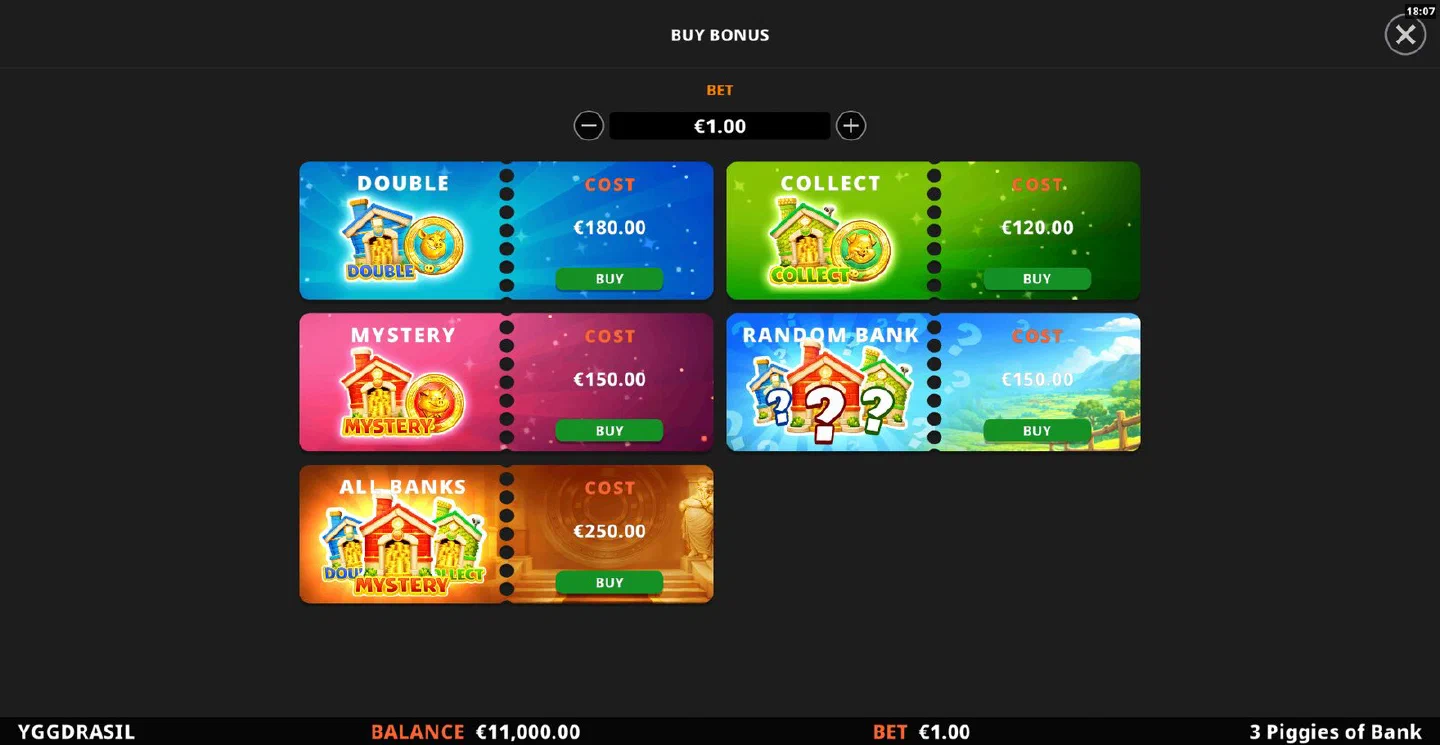
A 120x buy is 120 spins at the same bet. That translation is the entire strategy section on purchases, and it is worth repeating because it is so easily misread: a buy price is a price, never a frequency. Collect at 120x does not mean the feature arrives about every 120 spins. It means the round costs the same as 120 base spins at your current stake.
| Buy | Price | Equivalent in base spins | At EUR 0.10 | At EUR 1.00 |
|---|---|---|---|---|
| Collect bank | 120x | 120 spins | EUR 12.00 | EUR 120.00 |
| Mystery bank | 150x | 150 spins | EUR 15.00 | EUR 150.00 |
| Randomly selected bank | 150x | 150 spins | EUR 15.00 | EUR 150.00 |
| Double bank | 180x | 180 spins | EUR 18.00 | EUR 180.00 |
| All three banks | 250x | 250 spins | EUR 25.00 | EUR 250.00 |
All five carry the same theoretical return of 94.0%, which removes the usual question about value: nothing on the menu is a better deal than anything else, and the price differences describe what each bank does. Collect at 120x is the cheapest way in. Double at 180x is exactly one and a half times that, and it buys a bank that multiplies every Coin value on the board by x2 before the blue Coin takes its own 1x to 150x. All three banks at 250x costs less than buying Collect and Double as separate rounds, which would come to 300x.
Price the buys against the ladder as well as against the spins, because that is the comparison that tells you what a round is being bought for. All three banks at 250x sits above the Major at 200x and at a quarter of the Grand at 1,000x; and even the cheapest ticket, Collect at 120x, costs more than twice what the Minor at 50x pays. In plain cash at the EUR 1.00 stake: a EUR 250.00 ticket into a round whose ladder reads EUR 15.00, EUR 50.00, EUR 200.00 and EUR 1,000, with Coin values on top of whichever prize lands. That is the honest frame for a buy. It is a priced entry to the part of the game where the range lives, not a shortcut to the top of the column, and the 94.0% theoretical return applies to the purchase exactly as the configuration RTP applies to a base spin.
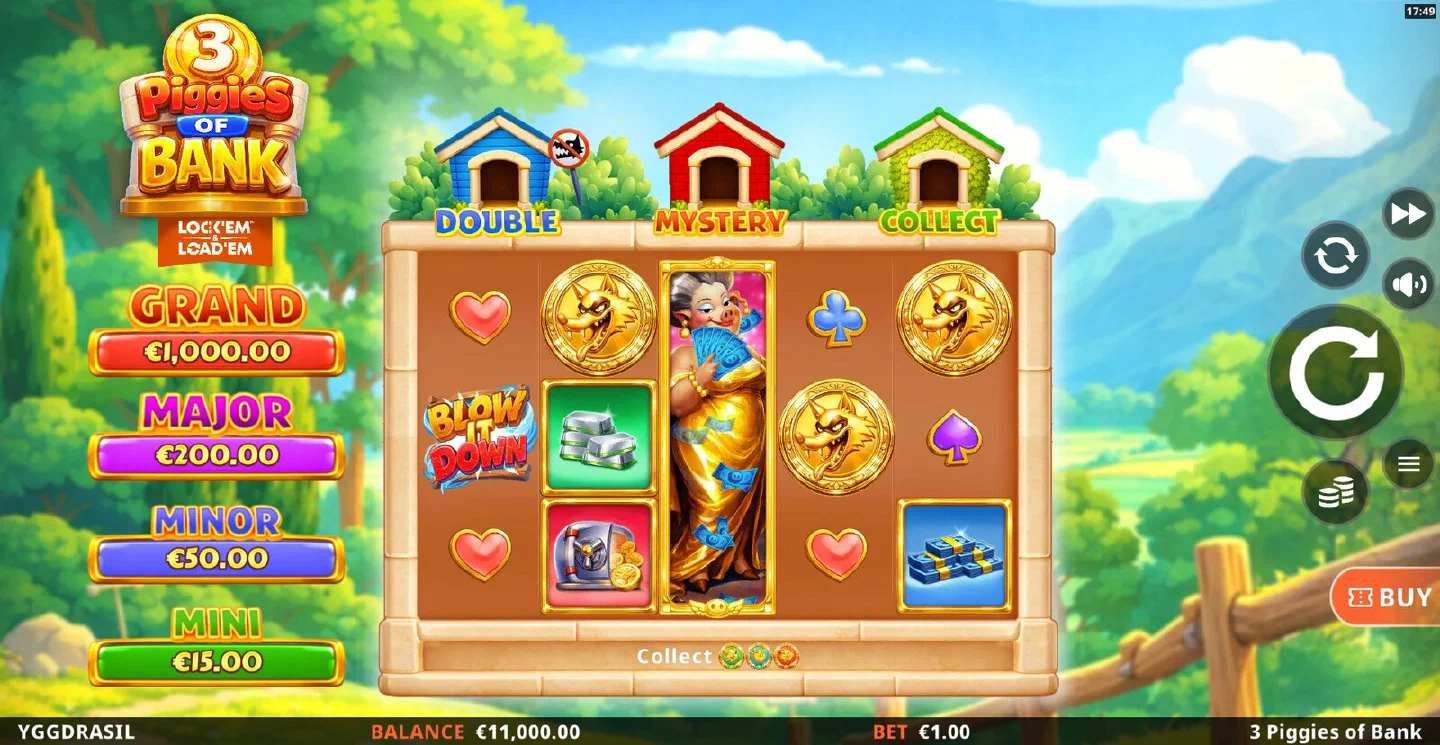
What you trade away is the base game. Two hundred and fifty spins at EUR 0.10 is a substantial stretch of play, with its own free spins, its own Mamma Pig expansions at 1x, 2x and 3x, and the chance of the bonus arriving on the house. Buying skips all of it. That is a perfectly reasonable trade if what you want is the Coin round (the ladder of Mini 15x, Minor 50x, Major 200x and Grand 1,000x lives there, and the Grand needs all 15 positions filled) but it should be a decision rather than a reflex. Build the plan around the buys your own panel offers, since the menu is assembled per market rather than per player.
Pace, Autoplay and the pause#
Set the stop before you start. The game panel carries an Autoplay control and the menu an Auto Spin entry, and where the market allows them they are pacing tools rather than shortcuts: a fixed number of spins at a fixed bet, with conditions that end the run. Used with a loss limit attached, Autoplay is the most disciplined way to play a low-volatility slot, because it removes the moment-by-moment decision that quietly stretches a session.
Not every panel carries it, and that is by rule rather than by omission: Yggdrasil ships Autoplay, the fast-spin button and the space-to-spin shortcut as market-dependent controls. Plan for the panel you actually have. Without Autoplay the discipline has to be manual, which means writing the stop condition down before you start instead of setting it in a dialog; the where to play page explains which rules produce which panel.
Two other controls deserve a place in a plan. Game History displays the last spins with an option to rewatch them, which is the honest way to settle an argument with yourself about what just happened in a bonus round. And if the connection drops, a round interrupted during play can be replayed within one hour of the interruption, after which the winnings are credited automatically, so stepping away from an unfinished round is an inconvenience, not a loss.
The deposit and session limits at your casino sit alongside all of this, and they are the outer frame of any plan worth having. Our responsible gambling page covers how to set them, and the where to play page covers what to look for in a lobby.
On cheats, systems and the RNG#
The outcome comes from the game’s random number generator, and RTP is a long-run average across four configurations. What you control is the bet, the pace and the limit, and that is enough to make the evening go the way you planned.
It is worth being concrete about where the boundary falls in this particular slot, because 3 Piggies of Bank has more visible moving parts than most. The Wolf Coin value of 1x to 10x is drawn by the game. The Mystery Coin landing on 15x, 30x, 50x, 75x, 100x or 150x is drawn by the game. Which colour of Piggie Coin opens the round, and therefore which of the three banks pays, is drawn by the game. The respin counter resetting on a new Coin is a rule, not a choice. Nothing in that list responds to timing, to bet patterns or to how long you have been playing.
What remains on your side of the line is real, though. You choose the configuration you play by choosing where you play, since the RTP line at your casino is one of 96%, 94%, 92% or 90.5% and the game info panel will tell you which. You choose the stake, which sets the cost of everything. You choose whether to buy a bank and which one. And you choose when the session ends. That is a genuine set of levers, and it is the only set there is.

Three ready-made session plans#
Pick the one that looks like your evening.
The quiet evening at EUR 0.10 a spin. A EUR 100 budget is a thousand spins, and the whole buy menu costs between EUR 12.00 and EUR 25.00. Play the base game for the free spins and the Mamma Pig expansions, and buy one bank when the mood changes. This is the plan the game was designed around.
The standard session at EUR 1.00 a spin. The default stake, a hundred spins from the same budget, and a Collect buy at EUR 120.00 that you would need to plan for rather than reach for. Best suited to a longer evening where the bonus is something you wait for: at a 25.2% hit frequency the base game will keep you company while you do.
Short and intense: buy first. Set the bet low, buy all three banks at 250x, and treat the round as the whole session. At EUR 0.10 that is EUR 25.00 for a Lock ’em & Load ’em round with every bank behaviour live, which is the most game per euro this slot sells. Decide in advance how many you are buying, and stop there. The hub page and the features page have the detail behind each of these.